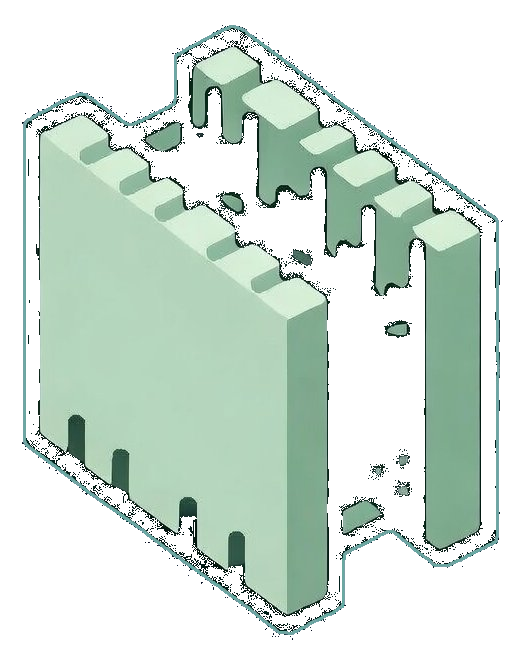
Before You Start: ICF Installation Prerequisites
Successful ICF installation requires proper planning and preparation. Before any forms arrive on site, ensure:
Pre-Installation Checklist
- Foundation/footing complete and cured (7 days minimum)
- Rebar dowels in place (per engineering specs)
- Foundation level within 1/4" across entire perimeter
- All materials delivered and staged
- Bracing equipment available and inspected
- Pour date confirmed with concrete supplier
- Weather forecast reviewed (no rain, not too hot)
- Crew trained on ICF techniques
ICF Installation: Step-by-Step
STEP 1 Layout & First Course
Snap chalk lines on the footing to mark inside and outside wall faces. Place the first course of ICF forms, starting at corners. Connect forms using the interlocking teeth (Nudura's Duralok system).
- Check level constantly—first course sets the tone for entire wall
- Use foam adhesive or mechanical fasteners to secure first course to footing
- Verify corners are square using 3-4-5 method or diagonal measurements
- Cut forms as needed with a hot knife or reciprocating saw
Pro Tip: First Course Perfection
Spend extra time getting the first course perfect. An out-of-level first course compounds errors with every additional course. Use shims if needed and verify with a transit or laser level.
STEP 2 Stacking Additional Courses
Stack subsequent courses in a running bond pattern (like bricks), offsetting vertical joints by at least 6 inches. Continue checking level and plumb as you go.
- Stagger joints—never stack vertical joints directly above each other
- Push blocks down firmly to engage interlocking teeth
- Cut height adjusters or filler pieces as needed for exact wall height
- Plan opening locations before you get too high to reach
STEP 3 Window & Door Bucks
Install bucks (frames) for all openings as walls reach opening height. Bucks can be pre-made (like PreBuck systems) or site-built from 2x lumber or steel.
- Bucks must be level, plumb, and square
- Brace bucks rigidly—they'll resist significant concrete pressure
- Install lintel reinforcement above openings (typically 2-#5 bars minimum)
- Extend jamb reinforcement above and below openings
Buck Failure = Disaster
An improperly braced buck can blow out during the pour, dumping concrete everywhere and potentially injuring workers. Double-brace all bucks and verify before pour day.
STEP 4 Horizontal Reinforcement
Place horizontal rebar as walls rise, per engineering specifications. Typical residential specs call for #4 horizontal at 24" vertical spacing, starting 8" from bottom and top.
- Overlap horizontal bars at splices by minimum 30 bar diameters (15" for #4)
- Tie horizontal rebar to vertical at intersections
- Maintain clear cover requirements (typically 1.5" from form face)
- Additional bars at openings, corners, and wall intersections
STEP 5 Vertical Reinforcement
Install vertical rebar from footing dowels up through the wall. Most residential ICF uses #4 vertical at 24" to 48" centers, but always follow your structural engineer's specs.
- Lap vertical bars onto footing dowels by minimum 30 diameters
- Tie horizontal and vertical bars at every intersection
- Maintain bar position—rebar should be in the center of the concrete core
- Double verticals at corners and wall ends
STEP 6 Bracing Installation
Install turnbuckle bracing before the pour. Bracing keeps walls plumb and aligned against the significant pressure of wet concrete (up to 600 PSF at 4-foot pour height).
- Use scaffold-grade or ICF-specific bracing systems
- Space vertical braces 4-6 feet apart
- Anchor braces to floor/foundation and to wall at attachment points
- Verify all walls are plumb after bracing is complete
Pro Tip: Brace Before You Need It
Install bracing by the time walls reach 4 feet. Don't wait until walls are full height—they can become unstable in wind or from accidental contact.
STEP 7 Pre-Pour Inspection
Before calling for concrete, conduct a thorough inspection of the entire wall system.
- All walls plumb and level? Check with transit or laser.
- All rebar in place and properly tied?
- All bucks secure and properly braced?
- All bracing tight and anchored?
- Electrical and plumbing sleeves in place?
- Any blowout risk areas reinforced?
STEP 8 Concrete Pour
Pour concrete in controlled lifts of no more than 4 feet vertically. Use a line pump or boom pump depending on access and wall height.
- Use concrete with 3/8" to 1/2" aggregate (larger aggregate can bridge webs)
- Target 5-6" slump for good flow and consolidation
- Pour in 4-foot lifts maximum—let each lift settle before continuing
- Vibrate lightly to consolidate (don't over-vibrate)
- Fill windows/doors to lintel height, then continue wall
- Watch for blowouts—have crew ready to patch immediately
Blowout Prevention
Most blowouts occur at weak points: form joints, cut locations, and below windows. Have extra forms, spray foam, and bracing ready. Stop pouring immediately if a blowout begins—contain it before continuing.
STEP 9 Curing & Stripping
Allow concrete to cure before removing bracing. Most residential projects can remove bracing after 24-48 hours in normal weather.
- Leave bracing in place minimum 24 hours (48+ hours in cold weather)
- Concrete reaches 70% strength in 7 days, full strength at 28 days
- Foam forms stay in place permanently—they're the insulation
- Trim excess foam at openings and attachment points
ICF Installation Specifications
| Specification | Typical Requirement | Notes |
|---|---|---|
| Vertical Rebar | #4 at 24-48" O.C. | Per engineering; double at corners |
| Horizontal Rebar | #4 at 24" O.C. | Per engineering; starting 8" from top/bottom |
| Concrete Strength | 3,000-4,000 PSI | Higher for commercial applications |
| Concrete Slump | 5-6 inches | Self-consolidating mixes work well |
| Aggregate Size | 3/8" - 1/2" max | Larger aggregate can bridge form webs |
| Pour Lift Height | 4 feet maximum | Allow settling between lifts |
| Brace Spacing | 4-6 feet O.C. | Closer for tall walls |
| Minimum Cure Time | 24-48 hours | Before removing bracing |
Common ICF Installation Mistakes
Mistake #1: Rushing the First Course
The first course sets the alignment for the entire wall. Rushing this step leads to out-of-level walls, corners that aren't square, and cumulative errors that compound with each course. Take your time—a perfect first course is worth an extra hour.
Mistake #2: Inadequate Bracing
Wet concrete exerts enormous pressure on ICF forms. Inadequate bracing leads to blowouts, bowed walls, and potentially catastrophic failures. When in doubt, add more bracing. Scaffold-grade bracing systems are worth the investment.
Mistake #3: Pouring Too Fast
Pouring concrete too quickly (more than 4 vertical feet per pass) builds up hydrostatic pressure that can blow out forms. Slow down, pour in lifts, and let each lift settle before continuing.
Mistake #4: Wrong Concrete Mix
Using concrete with aggregate too large (over 1/2") or slump too stiff can prevent proper filling of the form cavities. Always specify ICF-appropriate mix with 3/8" aggregate and 5-6" slump.
Mistake #5: Insufficient Rebar Lap
Rebar splices require minimum lap lengths to develop full strength. For #4 bar, the minimum lap is 15 inches (30 bar diameters). Short laps create weak points that can fail under load.
Get Professional ICF Training
Professional Building Supply offers free ICF installation training with qualifying material orders. Learn hands-on techniques from experienced ICF builders.
Learn About Training →