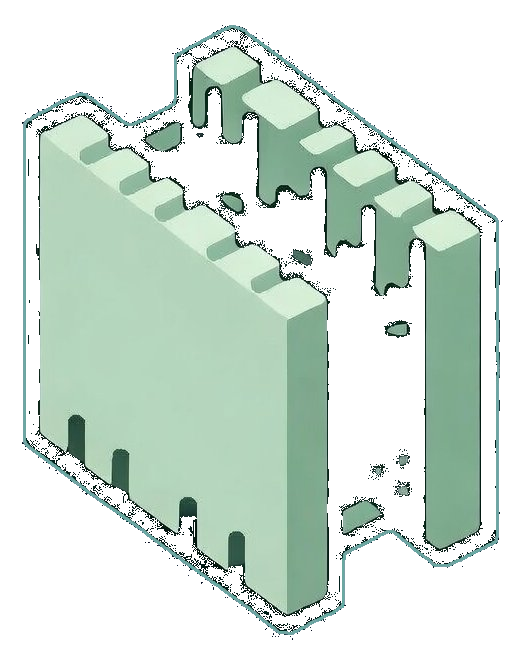
Why Use ICF for Pool Construction?
Traditional gunite/shotcrete pools have thick concrete walls, but they're uninsulated—heat escapes directly into the surrounding soil. ICF pool construction wraps the pool in insulation, dramatically reducing heat loss while providing a stronger structural wall.
🔥 70% Less Heat Loss
Insulated walls keep heat in the water instead of the ground. Heated pools cost significantly less to operate.
💪 Stronger Walls
Steel-reinforced concrete outperforms gunite. ICF pools better resist soil pressure and ground movement.
⚡ Faster Construction
ICF forms stack quickly. The pool shell can be poured in a single day once forms are set.
🌿 Year-Round Swimming
Insulated walls extend the swimming season by retaining heat longer into fall and starting earlier in spring.
ICF Pool vs. Traditional Gunite Pool
Construction Method Comparison
Heated Pool Efficiency
The economics of ICF pools become especially compelling for heated pools:
Real Numbers: Heated Pool Operating Costs
A 16×32 ft heated pool in Central Texas maintained at 82°F:
- Uninsulated gunite: ~$200/month heating (gas) or $250/month (electric)
- ICF pool: ~$60/month heating (gas) or $80/month (electric)
- Annual savings: $1,500-$2,000 per year
Over the 20+ year lifespan of a pool, those savings add up to $30,000-$40,000—far exceeding any premium for ICF construction. Plus, the pool heats faster and maintains temperature better during cold snaps.
ICF Pool Construction Process
1. Excavation
The pool is excavated to design depth plus room for ICF forms (typically 6-8" wider on each side than the finished pool dimension). A compacted gravel base is prepared for the floor.
2. Floor Slab
A reinforced concrete floor slab is poured first. This provides a level base for ICF walls and integrates with pool floor finishes. Plumbing and drains are stubbed through the slab.
3. ICF Wall Assembly
ICF forms are stacked on the floor slab to create pool walls. Most ICF pools use standard 6" core forms, though 8" is common for deeper pools or expansive soils. Horizontal and vertical rebar is placed per engineering specs.
4. Bracing
ICF walls are braced with standard turnbuckle systems. Proper bracing is critical—concrete pressure during pour is significant, and walls must remain plumb and aligned.
5. Concrete Pour
Concrete (typically 3,000-4,000 PSI with 3/8" aggregate) is pumped into the forms in controlled lifts. The entire shell can usually be poured in a single day, creating a monolithic structure.
6. Finishing
After curing, the interior foam is trimmed smooth. The pool receives standard finishing: plaster, pebble, tile, or other surfaces applied directly over the concrete core.
Best ICF Products for Pools
Pool applications have specific requirements. Here's what works best:
| ICF Product | Best For | Notes |
|---|---|---|
| Nudura ONE Series | Pool walls (interior exposed) | Foam on soil side only; concrete surface receives finish directly |
| Nudura Standard 6" | Standard depth pools | Full insulation both sides; interior foam removed before finish |
| Nudura Standard 8" | Deep pools, expansive soils | Extra strength for soil pressure at depth |
Nudura ONE Series for Pools
The ONE Series is particularly well-suited for pools. With foam on only the exterior (soil) side, the concrete interior is ready for pool finishes without stripping interior foam. This saves labor and provides the insulation where it matters—between the water and the soil.
ICF Pool Design Considerations
Depth Limitations
ICF walls can be engineered for any pool depth. However, deeper pools (8'+) may require thicker cores (8" or 10") or additional horizontal rebar to handle increased soil pressure at the base.
Curved Walls
ICF pools are typically designed with straight walls or simple curves. Complex freeform shapes are easier with gunite. However, straight-walled pools with ICF can incorporate radius corners and gentle curves.
Benches and Steps
Built-in benches, tanning ledges, and steps are formed using additional ICF sections or poured concrete. These integrate seamlessly with ICF walls and benefit from the same insulation.
Spas and Water Features
Attached spas are excellent ICF applications. The insulation is particularly valuable for spas maintained at 100-104°F, where heat loss to soil would otherwise be extreme.
ICF Pool Cost Comparison
ICF pool construction typically adds 10-15% to the shell cost compared to gunite. For a $60,000 pool, that's approximately $6,000-$9,000 more. However:
- Heated pool payback: 3-5 years through energy savings
- Unheated pool payback: Extended swimming season and comfort
- Durability: Fewer repairs from soil movement over pool lifetime
- Resale value: Energy-efficient pool is a premium feature
Texas ICF Pool Advantages
ICF pools are particularly well-suited to Texas conditions:
- Expansive clay soils: ICF's reinforced concrete resists soil pressure better than gunite
- Extreme heat: Insulation keeps water cooler during summer, reducing evaporation
- Extended season: Retain fall heat longer, start spring swimming earlier
- Energy costs: Texas electricity rates make efficiency savings significant
Build an ICF Pool in Texas
Professional Building Supply provides Nudura ICF forms for pool construction. We can help with material selection, takeoffs, and connect you with ICF-experienced pool contractors.
📞 Call 512-410-9692