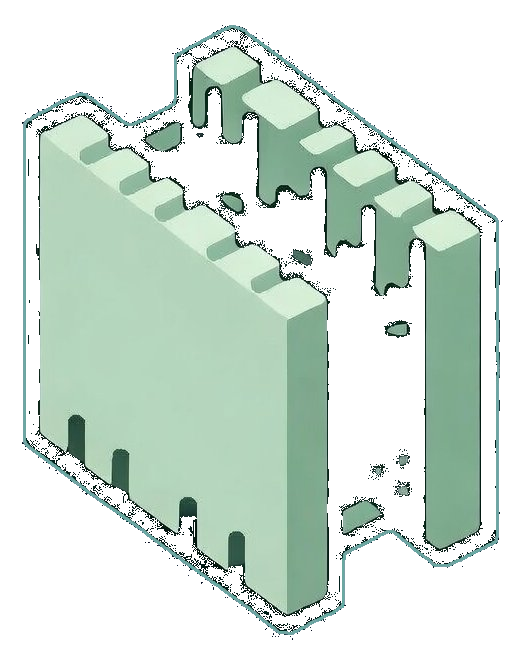
ICF Wall System Overview
ICF (Insulated Concrete Form) walls consist of hollow expanded polystyrene (EPS) foam forms that are stacked, reinforced with steel rebar, and filled with concrete. The result is a solid reinforced concrete wall with continuous insulation on both sides—no thermal bridging, no air gaps, no weak points.
Unlike wood frame walls where insulation fills cavities between studs (with studs creating thermal bridges every 16 inches), ICF walls provide uninterrupted insulation across the entire wall surface. This fundamental difference explains why ICF walls dramatically outperform frame walls in real-world energy testing.
ICF Wall Components
- EPS Foam Forms: Expanded polystyrene panels (typically 2-5/8" to 4-1/4" thick on each side) connected by plastic or steel webs
- Concrete Core: Reinforced concrete (usually 3,000-4,000 PSI) in 6", 8", 10", or 12" thicknesses
- Steel Reinforcement: Horizontal and vertical rebar (typically #4 or #5) at 12" to 24" centers per engineering
- Web/Tie System: Plastic or metal ties connecting foam panels, with embedded strips for interior/exterior finish attachment
ICF Wall R-Values
R-value measures thermal resistance—how well a material prevents heat transfer. Higher R-values mean better insulation. But for walls, what matters isn't just the insulation's R-value; it's the "whole wall" R-value that accounts for all thermal bridging.
| ICF Product | Foam Thickness | Foam R-Value | Whole Wall R-Value* |
|---|---|---|---|
| Nudura Standard | 2-5/8" each side (5-1/4" total) | R-24 | R-25+ |
| Nudura Plus+ | 4-1/4" each side (8-1/2" total) | R-35 | R-35+ |
| Nudura XR35 | 4-1/4" + 2-5/8" (6-7/8" total) | R-35 | R-35+ |
| Nudura XR48 | 4-1/4" each side + extra | R-48 | R-48+ |
| Nudura ONE Series | 2-5/8" one side only | R-12 | R-12.5 |
*Whole wall R-value includes concrete thermal mass benefits per ORNL/ASHRAE testing protocols.
ICF vs Wood Frame: Real R-Value Comparison
On paper, a 2x6 wood frame wall with R-19 fiberglass looks comparable to standard ICF. In reality, it's not even close:
The wood frame wall loses 30%+ of its rated R-value due to thermal bridging at studs, headers, plates, and corners. ICF has no thermal bridges—the insulation is continuous.
Thermal Mass Bonus
ICF walls include 6-12 inches of concrete that acts as thermal mass, absorbing heat during the day and releasing it slowly. The ORNL (Oak Ridge National Laboratory) estimates this thermal mass effect adds the equivalent of R-5 to R-9 in hot climates like Texas, on top of the foam's R-value. This is why ICF homes in Texas often see 50-70% energy savings despite only R-25 walls.
Structural Specifications
ICF walls are structural reinforced concrete walls. They carry loads, resist lateral forces, and provide shear resistance far exceeding wood frame or CMU construction.
| Specification | Typical Value | Notes |
|---|---|---|
| Concrete Strength | 3,000-4,000 PSI | Standard residential; higher for commercial |
| Rebar Size | #4 or #5 | Per engineering; #4 most common residential |
| Vertical Rebar Spacing | 12" to 48" O.C. | Per engineering; 24" typical |
| Horizontal Rebar Spacing | 16" to 48" O.C. | Per engineering; 24" typical |
| Core Thickness Options | 4", 6", 8", 10", 12" | 6" and 8" most common residential |
| Wind Resistance | 200+ MPH | Exceeds all hurricane zone requirements |
| Seismic Performance | Seismic Design Category A-F | Meets all seismic zones with proper engineering |
Load-Bearing Capacity
An 8" ICF wall with standard reinforcement can support:
- 3+ stories of residential construction
- Roof loads up to 100 PSF (dead + live)
- Floor loads from engineered floor systems
- Lateral loads exceeding code minimums by 2-3x
For most residential applications, a 6" core is structurally adequate. 8" cores are common for two-story homes and provide additional mass for energy performance.
Fire Resistance
ICF walls achieve exceptional fire ratings due to their concrete core:
ICF Fire Rating: 4 Hours
Standard ICF walls (6" core) achieve a 4-hour fire rating per ASTM E119 testing. This means the wall maintains structural integrity and prevents fire spread for 4 hours—far exceeding the 1-hour typical of wood frame construction.
Key fire performance characteristics:
- Concrete doesn't burn: The core is non-combustible and maintains structural integrity at high temperatures
- EPS foam is self-extinguishing: Contains fire retardant; doesn't sustain flame when fire source is removed
- Slower fire spread: Fire can't travel through wall cavities like in frame construction
- Insulation protection: Even after a fire, the concrete core often remains intact and reusable
Sound Transmission (STC Ratings)
Sound Transmission Class (STC) measures how well a wall blocks airborne sound. Higher numbers mean quieter interiors. ICF walls significantly outperform frame construction:
| Wall Type | STC Rating | Subjective Description |
|---|---|---|
| Standard 2x4 Wood Frame | STC 33-35 | Normal speech easily understood |
| 2x6 Wood Frame with Insulation | STC 36-39 | Loud speech understood |
| Double Drywall Wood Frame | STC 40-45 | Loud speech heard but not understood |
| Standard ICF (6") | STC 50-52 | Loud sounds barely heard |
| ICF with 8" Core | STC 54-56 | Most sounds inaudible |
For reference, STC 50 is the minimum recommended for luxury hotels between guest rooms. ICF homes routinely achieve this level on exterior walls, making traffic, lawnmowers, and neighbors effectively inaudible.
ICF Wall Costs
ICF wall costs depend on the product series, core thickness, and local labor rates. Here are typical 2026 costs for Texas:
| Component | Cost Range | Notes |
|---|---|---|
| Standard ICF Forms (material) | $4.50-$6.00/sq ft | Wall area; includes corners |
| Concrete | $150-$180/cu yd | Delivered & pumped; 6" walls ~0.015 yd³/SF |
| Rebar | $0.75-$1.25/sq ft | Installed; standard residential spacing |
| Bracing System | $0.75-$1.00/sq ft | Rental + installation |
| Labor (stacking/pour) | $3.00-$5.00/sq ft | Varies by market & crew experience |
| Total ICF Wall System | $12-$18/sq ft | Complete wall, ready for finish |
Compared to wood frame: Wood frame walls with insulation cost approximately $8-$12/sq ft installed. ICF adds $4-$6/sq ft to wall costs, but this is offset by smaller HVAC systems (2-3 tons less in a typical home), lower energy bills, and insurance discounts.
ICF Wall Installation Details
Foundation Requirements
- Footings must be level within 1/4" for proper first-course alignment
- Rebar dowels (typically #4) extend 24" minimum from footing into wall
- Dowel spacing matches vertical rebar layout (usually 24" or 32" O.C.)
- Waterproofing/dampproofing applied to foundation before backfill
Typical Rebar Requirements
- Vertical: #4 at 24" O.C. minimum; corners get 2 bars
- Horizontal: #4 at 24" O.C. starting 8" from floor/ceiling
- Openings: 2 bars at jambs, lintel reinforcement above headers
- Lap splices: Minimum 30 bar diameters (15" for #4)
Concrete Requirements
- Strength: 3,000 PSI minimum; 4,000 PSI recommended
- Slump: 5-6" typical; self-consolidating mixes work well
- Aggregate: 3/8" to 1/2" pea gravel; large aggregate can bridge webs
- Lift height: 4 feet maximum per pour; vibrate to consolidate
Window and Door Openings
- Use pre-fabricated bucks (like PreBuck) or site-built wood/steel frames
- Bucks must be rigidly braced to resist concrete pressure
- Lintel reinforcement per engineering (typically 2-#5 bars minimum)
- Jamb reinforcement extends above and below opening
Need ICF Wall Materials?
Professional Building Supply stocks the complete Nudura ICF product line with free material takeoffs and contractor training.
📞 Call 512-410-9692